mTRUST7 — Minfy's Trustworthy Enterprise AI Operating Model

Trustworthy Enterprise AI Architecture | mTRUST7 by Minfy

|

By

Anirban De

November 27, 2026

A reference architecture in which every consequential AI decision produces evidence automatically.

Introduction

The Trustworthy Enterprise AI Operating Model defines what an enterprise must govern. The reference architecture defines where that governance becomes visible.

This distinction matters because mTRUST7 is not intended to remain a set of principles, and the operating model only becomes durable when its pillars are expressed through architectural controls, telemetry, evidence stores, review cadences, and enforcement points that operate every day, not only when an audit begins. Trust is not a feature added at the end of a project but an operating model for designing, deploying, running, governing, and continuously improving AI across its lifecycle.

The reference architecture shows how the seven pillars of mTRUST7 are evidenced in an enterprise architecture, how maturity can be assessed through architectural artefacts rather than interviews alone, and how a security enforcement layer integrates AI workloads into the enterprise security posture. It is hyperscaler-agnostic by design: its concepts apply equally across public cloud, sovereign cloud, and hybrid environments.
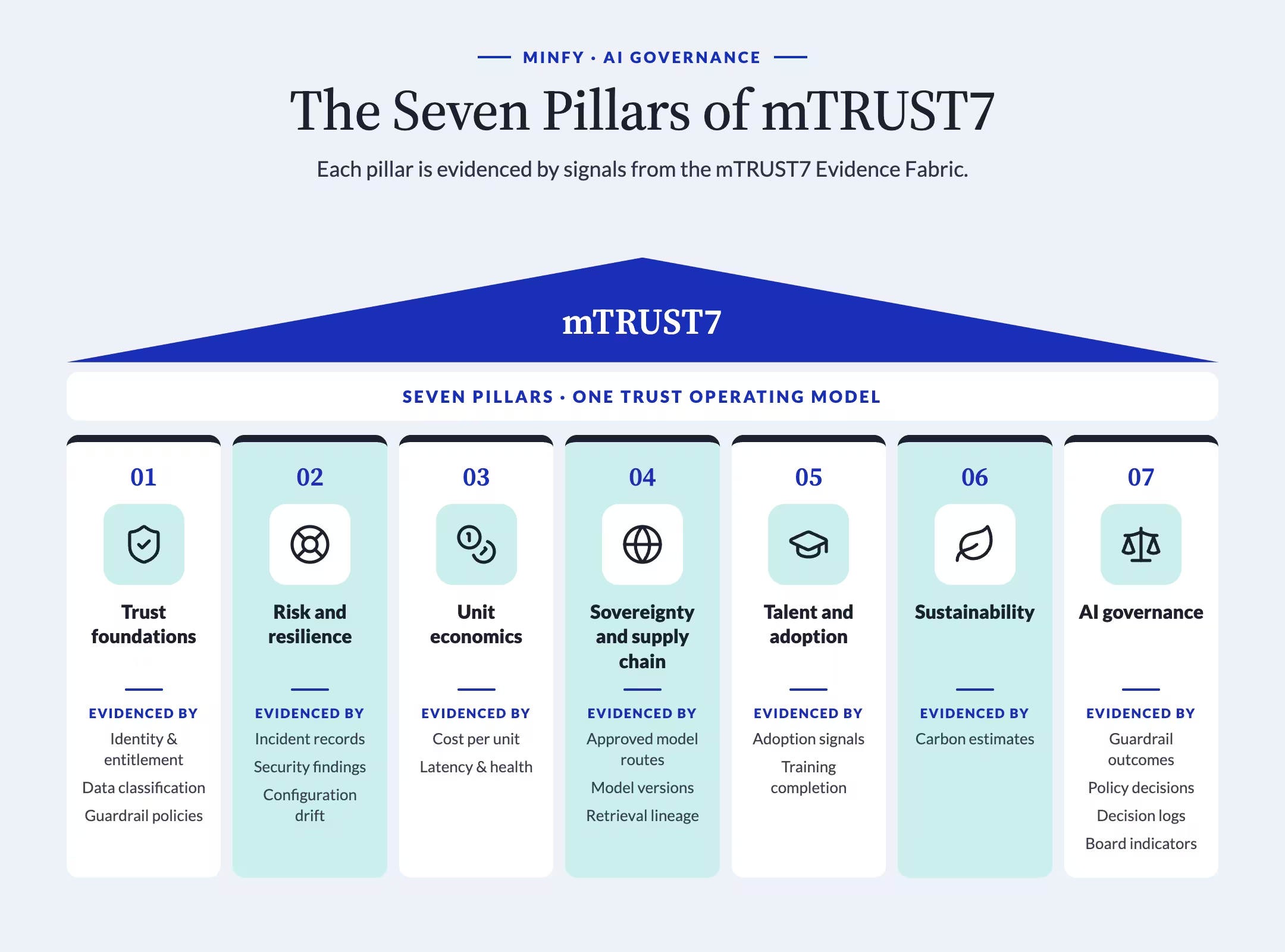
The seven pillars of mTRUST7

‍

Architectural Principle

THE MTRUST7 PRINCIPLE‍

A trustworthy AI architecture is one in which every consequential AI decision produces evidence automatically.

Evidence is the architectural currency of trust: a fairness claim without measurement is an opinion, a security posture without telemetry is an assertion, a model inventory without freshness is a spreadsheet, and a board report without lineage is a slide.

In practical terms, every production AI workload must be connected to five architectural capabilities:

  1. A governed AI control plane that registers workloads, models, agents, tools, data sources, owners, policies, and approvals. ‍
  2. A trusted execution plane that routes requests through model gateways, retrieval services, guardrails, tool invocation controls, and agent orchestration boundaries. ‍
  3. A security enforcement layer that applies identity, threat detection, egress control, logging, incident response, and infrastructure hardening to AI workloads. ‍
  4. An evidence and observability layer that captures telemetry, audit trails, model metadata, cost signals, carbon indicators, adoption metrics, and incident records.
  5. ‍A governance and maturity layer that converts evidence into operating reviews, maturity scoring, board reporting, regulatory mapping, and continuous improvement.

These five capabilities are architectural responsibilities rather than products, so while the service choices used to realise them will vary by workload, region, industry, and enterprise standard, the responsibility itself does not.

‍Reference Architecture

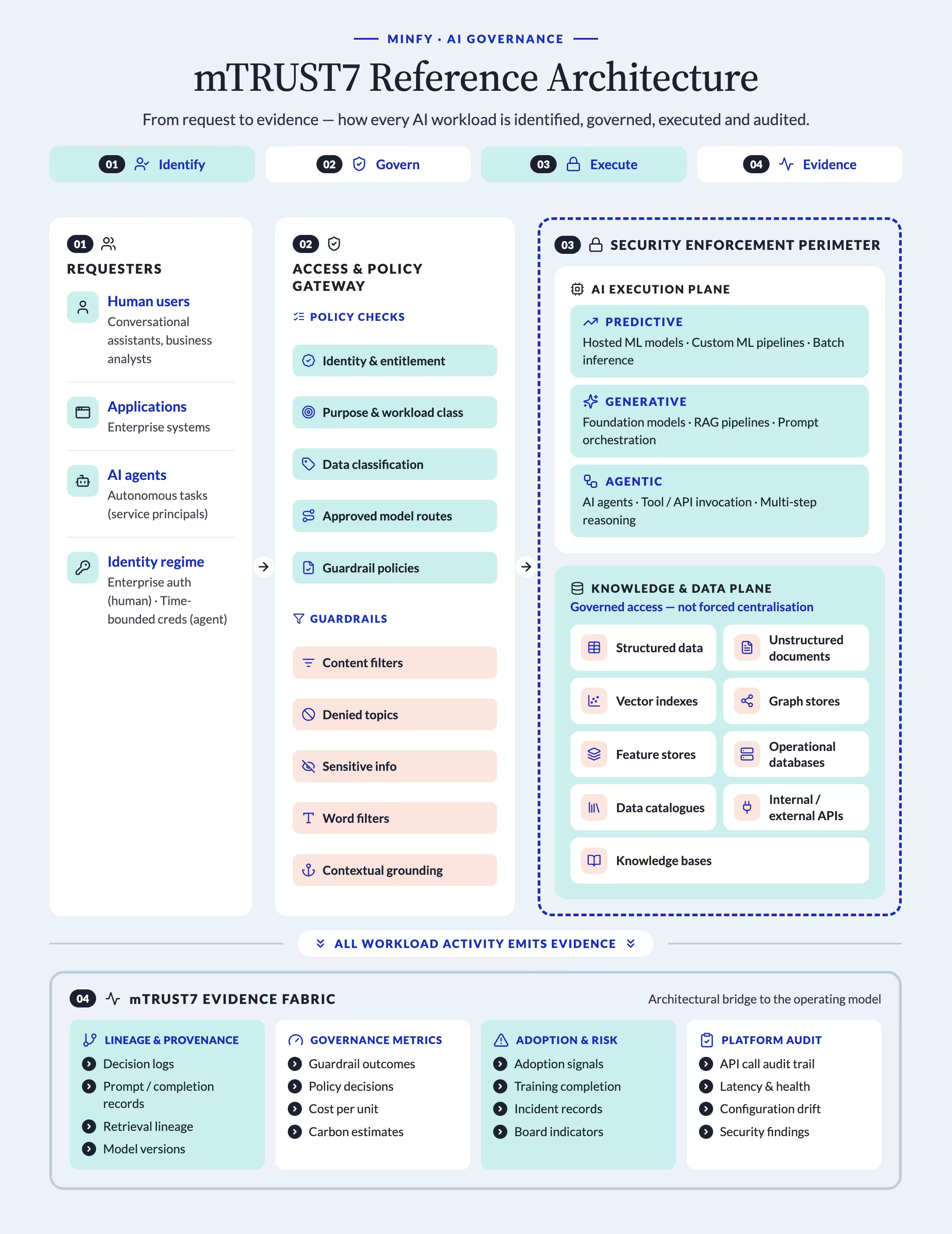
Figure 1: mTRUST7 reference architecture—logical view (At a logical level, the architecture can be read from left to right.)

‍

Requesters

Users, applications, and agents initiate requests, and each requester is treated as an accountable principal: human users authenticate through enterprise identity, while AI agents are represented as service principals with least-privilege permissions, time-bounded credentials, and full activity logging.

AI access and policy gateway

Requests enter an AI access and policy gateway, the point at which identity, entitlement, purpose, workload classification, data classification, approved model routes, guardrail policies, and logging obligations are resolved. Guardrails apply safety policies across model inputs and outputs, including content filters, denied topics, sensitive information filters, and contextual grounding checks.

AI execution plane

The gateway routes permitted requests into the AI execution plane, which contains three families of workloads: predictive models, generative AI applications, and agentic workflows that invoke tools, APIs, and enterprise systems under policy control.

Enterprise knowledge and data plane

The mTRUST7 architecture does not assume that all data has been centralised; it assumes the enterprise reality that data is distributed, sensitive, unevenly documented, and governed by different policies, which is why the architectural pattern is governed access rather than forced centralisation.

Security enforcement layer

Surrounding the execution and data planes, the security enforcement layer establishes the security perimeter, identity posture, detection pipeline, logging backbone, and incident response integration for AI workloads.

mTRUST7 evidence fabric

All workload activity emits evidence into the mTRUST7 evidence fabric, the architectural bridge between the running system and the operating model. It captures decision logs, retrieval lineage, model versions, guardrail outcomes, policy decisions, cost per unit, carbon estimates, adoption signals, incident records, and board-reportable indicators.

IN ONE SENTENCE

This reference architecture is the structure through which mTRUST7 becomes observable, security becomes enforceable, and enterprise AI becomes governable at boardroom scale.

Trustworthy AI is not achieved by adding a guardrail to a model call or a policy to a slide deck; it is achieved when every AI workload is registered, every consequential decision can be reconstructed, every agent acts as an accountable principal, every pillar emits evidence, every risk has an enforcement path, and every board report is grounded in the behaviour of the system itself.

‍

How mTRUST7 Is Evidenced in the Architecture

Pillar 1: Trust foundations

Becomes visible where the architecture explains, constrains, and measures AI behaviour.

It is evidenced through model cards, bias and fairness measurement pipelines, explanation records, hallucination controls, privacy filters, retrieval lineage, and human review pathways. A workload cannot claim this pillar merely because the model provider publishes a responsible AI statement; it must produce its own evidence.
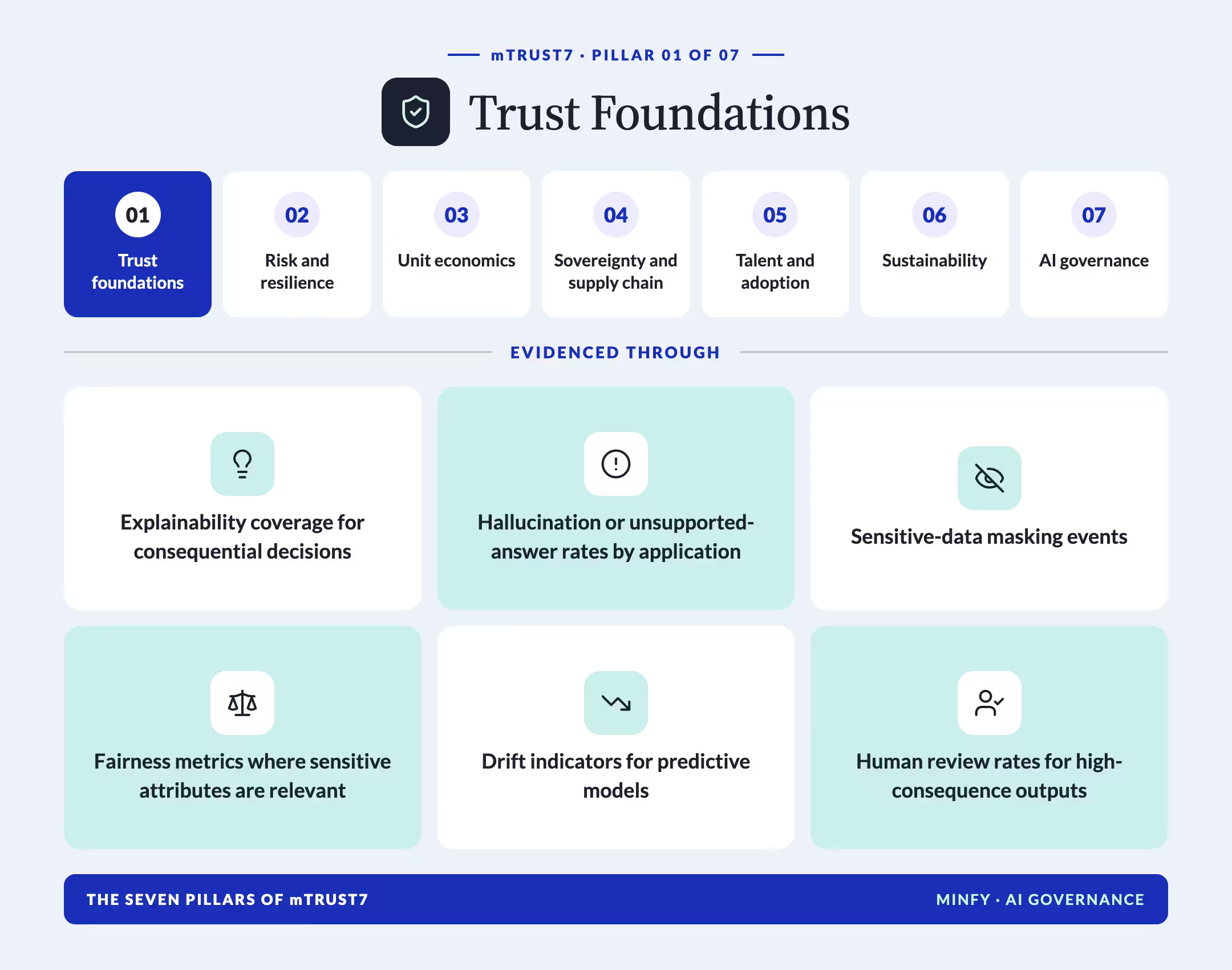
Figure 2: Trust foundations

‍

Pillar 2: Risk and Resilience

Becomes visible where the architecture anticipates failure, detects it, contains it, and reconstructs it.

The security enforcement layer is the primary enforcement layer for this pillar, ensuring AI workloads inherit enterprise controls for identity, logging, network boundaries, threat detection, and incident response. Agent invocations and tool actions should be correlated with the principal, model version, retrieved context, downstream system accessed, and policy decision.

Without this enforcement, risk and resilience would remain a promise, whereas with it, risk and resilience becomes an enforceable posture.
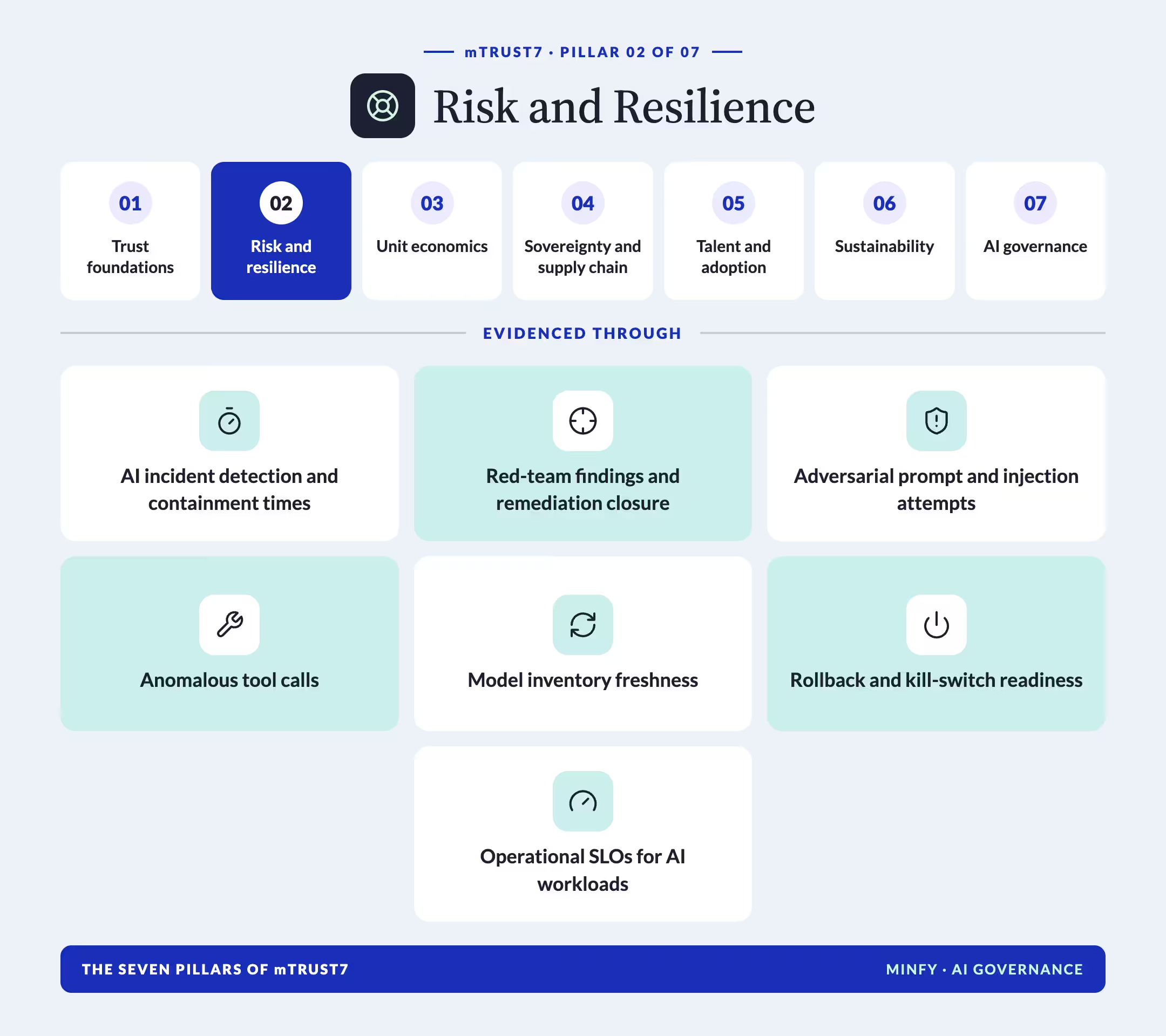
Figure 3: Risk and Resilience

‍

Pillar 3: Unit economics

Becomes visible where AI consumption is measured per unit of business value.

AI economics cannot be governed through total cost of ownership alone, because the relevant unit may be cost per query, per agent action, per transaction, or per recommendation. The goal is not to make enterprises artificially cost-constrained but to make economic behaviour visible before scale turns a design choice into a budget event.
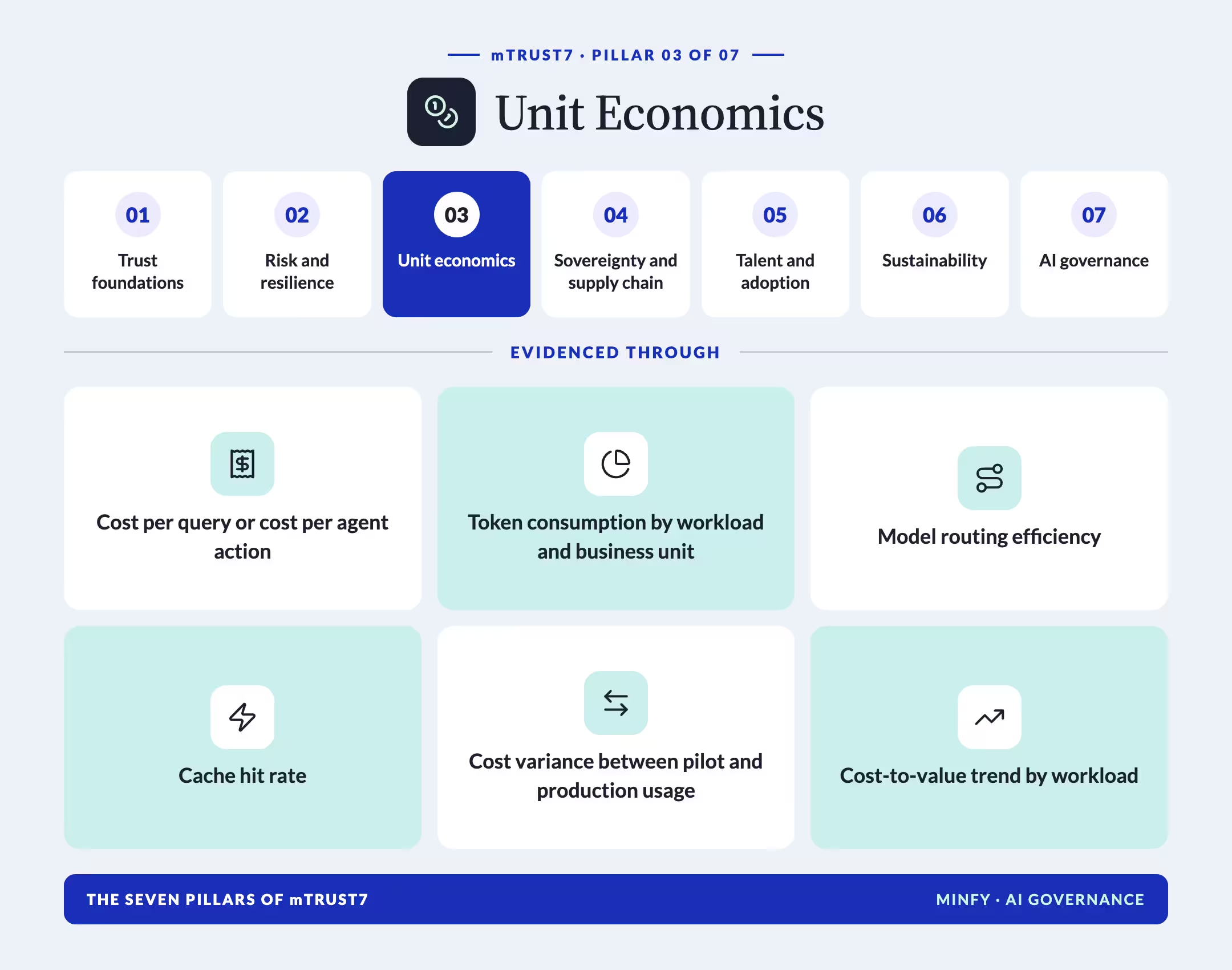
Figure 4: Unit economics

Pillar 4: Sovereignty and supply chain

Becomes visible where the architecture can answer: where does the workload run, where does the data move, what providers does it depend on, and what happens if one of them changes.

The architecture includes a dependency inventory, data residency policy, provider abstraction layer, model route registry, and exit playbook. Model calls should be abstracted behind an internal AI gateway so that model-provider changes are governed rather than hard-coded into application logic.

If a regulator asks where the data went, or if a provider deprecates a model, the enterprise should not need a forensic project to answer.

Figure 5: Sovereignty and supply chain

‍

Pillar 5: Talent and adoption

Becomes visible where the architecture supports safe use, role-specific enablement, and adoption measurement.

Although this pillar is often mistaken for a change-management appendix, it determines whether people accept and benefit from AI, spanning AI literacy, role redesign, workforce engagement, employee monitoring boundaries, and transition planning.

Adoption must be measured through usage and behaviour, not inferred from launch communications.
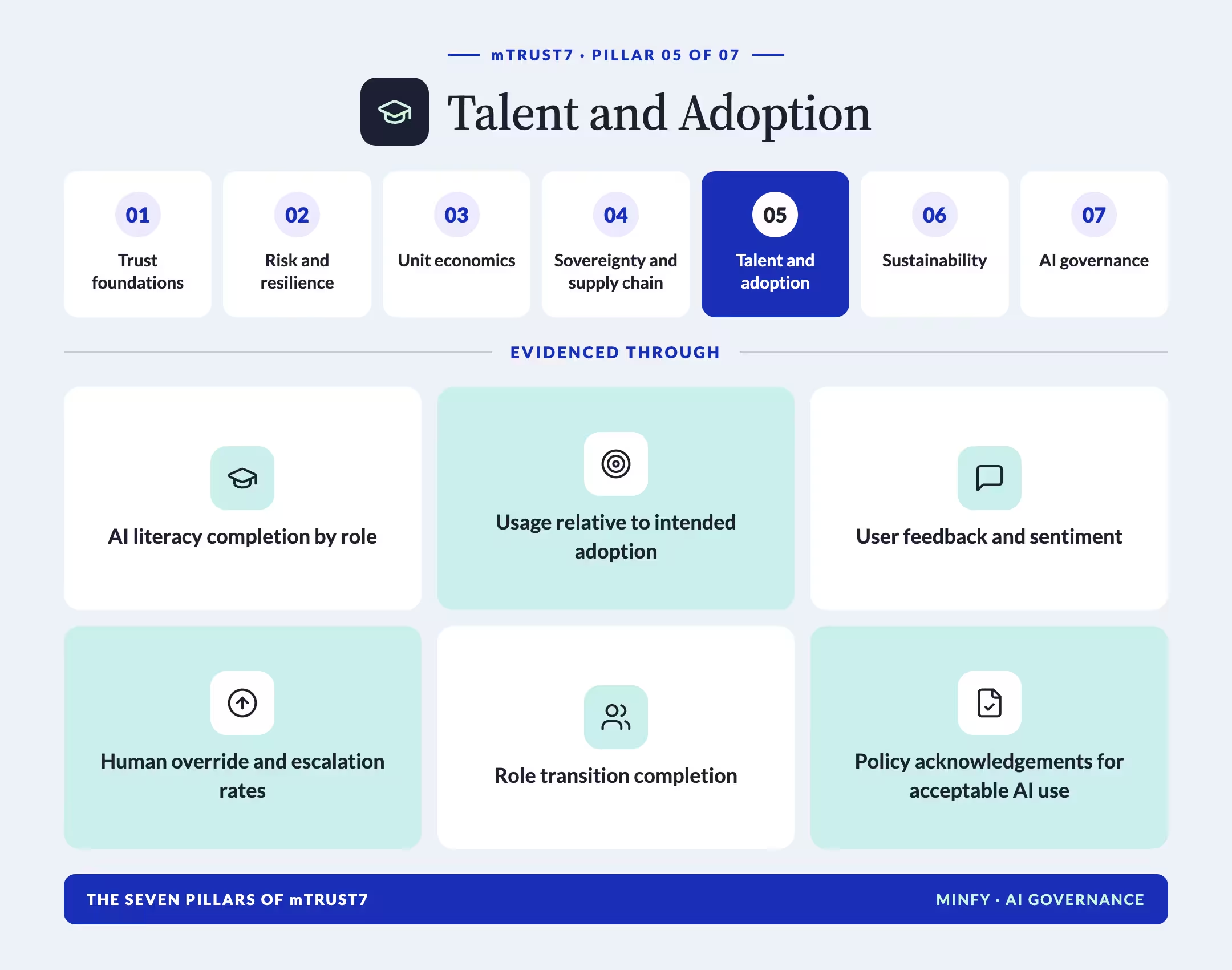
Figure 6: Talent and adoption

‍

Pillar 6: Sustainability

Becomes visible where AI consumption is attributed to workloads and connected to enterprise environmental reporting.

Sustainability telemetry is connected to the same workload registry that supports cost attribution, capturing model selection, inference volume, compute usage, region, batch versus synchronous patterns, caching effectiveness, and workload criticality.

The same architectural decisions that reduce token consumption and unnecessary inference often reduce environmental footprint.
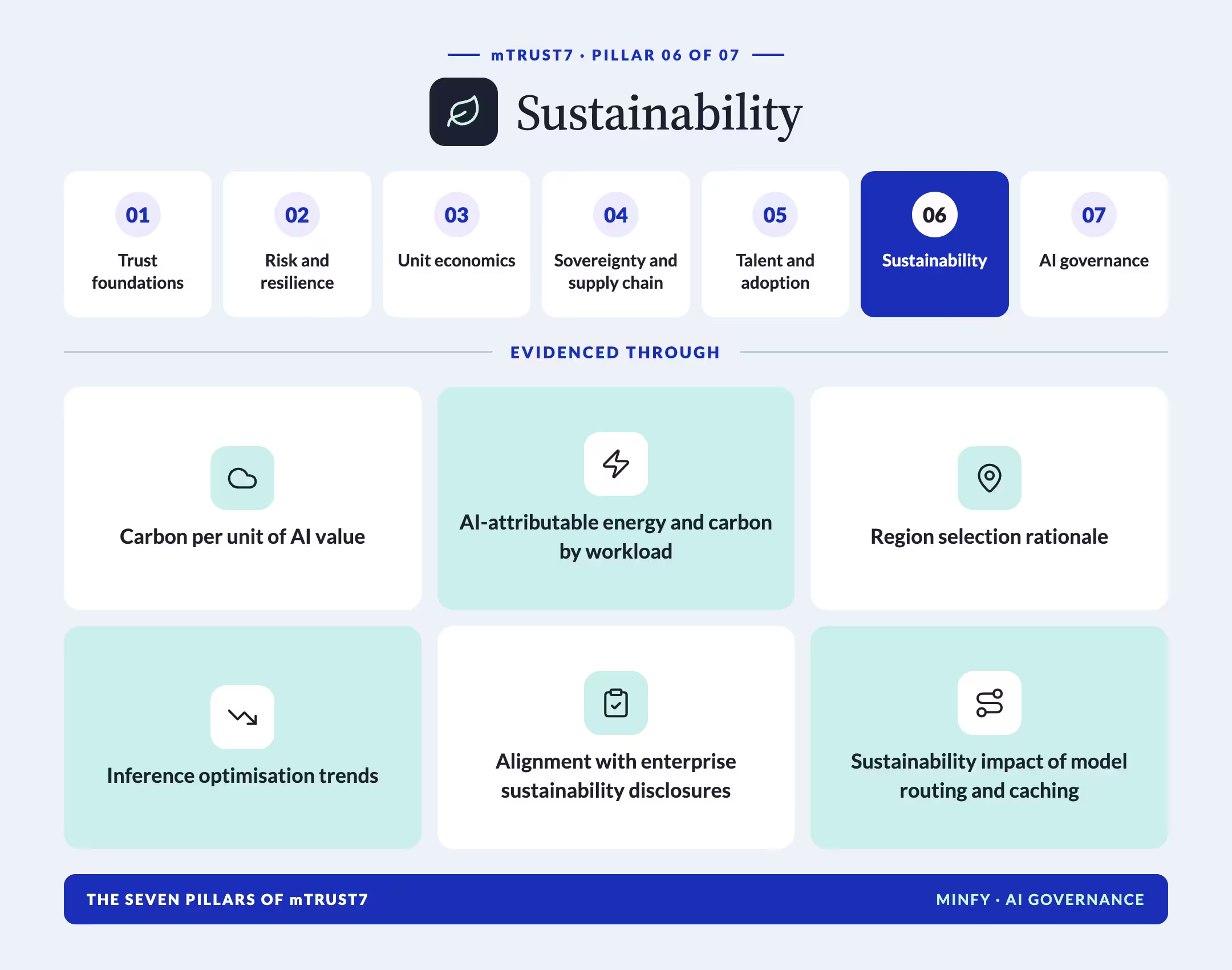
Figure 7: Sustainability

‍

Pillar 7: AI governance

Becomes visible where accountability is allocated, evidence is retained, and review cadence is observed.

It answers the question of who is accountable for the AI, with what evidence, and to whom. The model card is not a manually assembled PDF created at launch; it is a living artefact generated from the development and operations pipeline. The audit trail is not a debugging log; it is a regulatory and litigation artefact that allows consequential decisions to be reconstructed months later.

This is the layer that turns the rest of the architecture into boardroom trust.
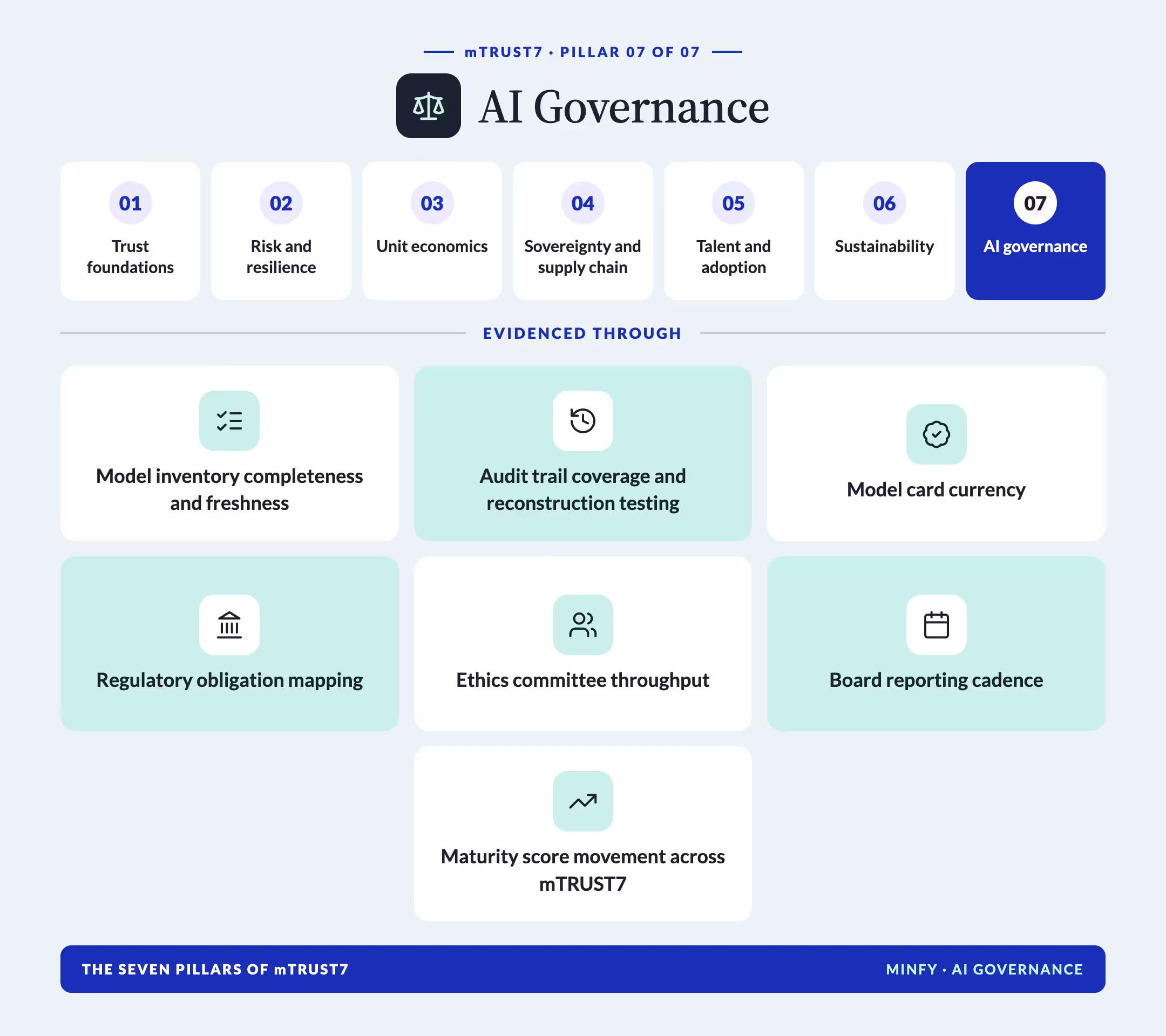
Figure 8: AI governance

‍

The Security Enforcement Layer

Rather than being the AI platform, the model gateway, or the governance dashboard, the security enforcement layer ensures that AI workloads inherit the same disciplined security posture as the rest of the enterprise, while adding the AI-specific controls that traditional security programsmes did not previously require, and it integrates at three points.

‍Identity

Every AI agent, model endpoint, orchestration service, and tool-calling function must operate as an identifiable principal, with least-privilege access, short-lived credentials where appropriate, and full activity logging, since agentic autonomy does not reduce the need for identity discipline but increases it.

Threat detection

The enterprise detection pipeline is extended with AI-specific signals: prompt injection attempts, indirect prompt injection through retrieved content, anomalous tool calls, unusual model invocation patterns, sensitive data exfiltration attempts, model probing, and guardrail bypass attempts.

Infrastructure perimeter

AI workloads should not sit outside the enterprise perimeter simply because they are new, and should instead inherit network segmentation, egress controls, encryption, logging, backup, disaster recovery, vulnerability management, and incident response patterns.
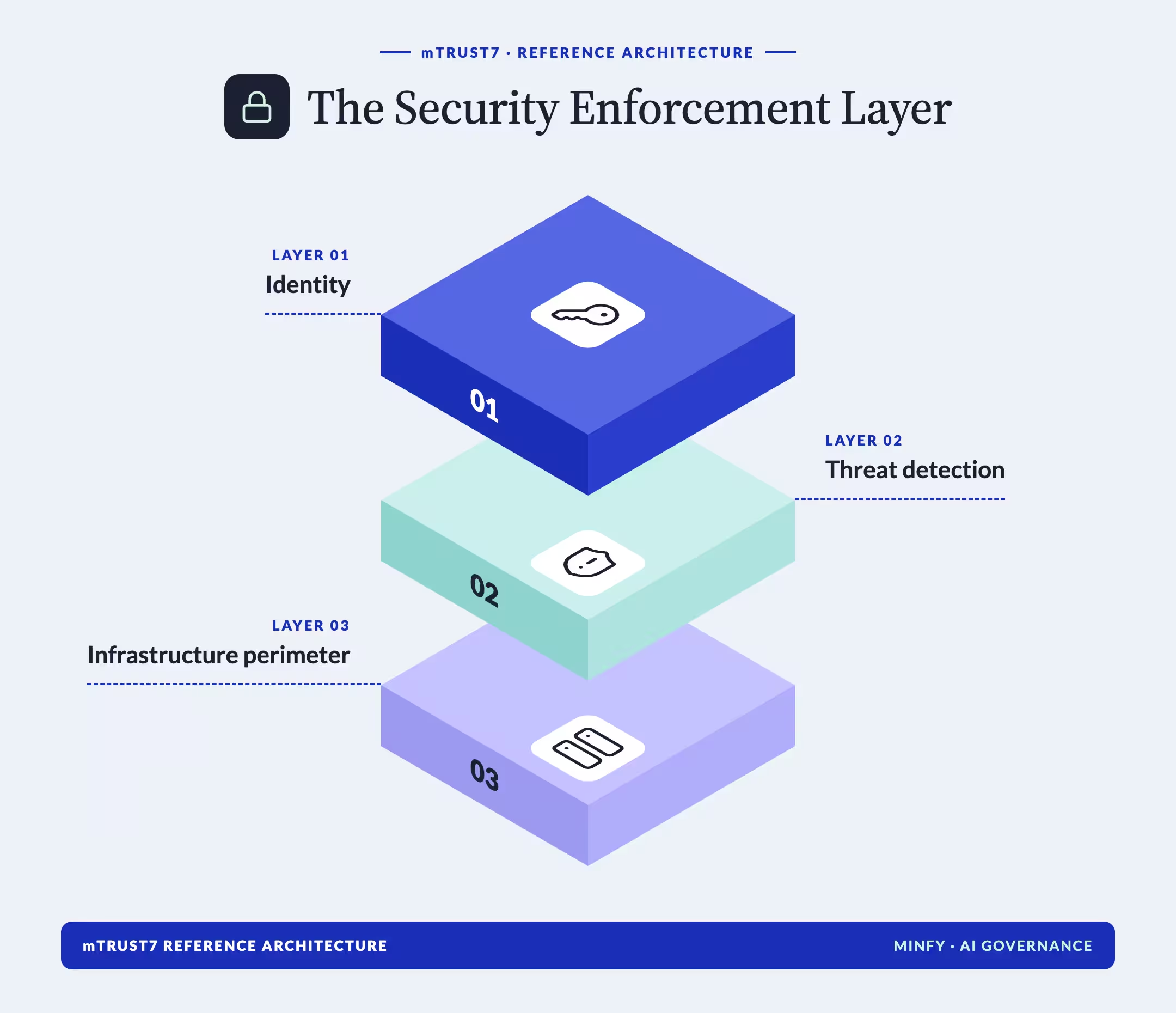
Figure: The Security Enforcement Layer

‍

The integration principle: AI security should not become a separate security estate, because as AI workloads multiply, security separation produces gaps and duplications, both of which are failure modes the security programme is meant to prevent.

‍

From Assurance to Evidence

Organisations must establish governance foundations before deploying AI workloads, ensuring that control planes, policy frameworks, and evidence capture mechanisms are operational. A phased approach, starting with pilot workloads in controlled environments before expanding to enterprise scale, works best, supported by cross-functional collaboration between security, data governance, AI, and infrastructure teams.

With evidence collected from day one, organisations can answer critical governance questions through observable system behaviour: which models are in use, who is accessing them, what data sources inform decisions, what costs are incurred per workload, and what security incidents have occurred. Compliance moves from a documentation exercise to a continuous monitoring discipline, with accountability embedded in the architecture itself.

That is the difference between an AI program that claims trust and an AI program that can prove it.

‍

Ready to make your enterprise AI provably trustworthy?

Talk to Minfy about assessing your AI workloads against the seven pillars of mTRUST7 and building an architecture that produces evidence by design.


Anirban De
SVP - Data Practice & CoE
|
November 27, 2026

Leave a Reply

Thank you! Your submission has been received!
Oops! Something went wrong while submitting the form.

Stay Ahead of Tech Trends.

blogs  |
November 27, 2026

mTRUST7 — Minfy's Trustworthy Enterprise AI Operating Model

A reference architecture in which every consequential AI decision produces evidence automatically.

Introduction

The Trustworthy Enterprise AI Operating Model defines what an enterprise must govern. The reference architecture defines where that governance becomes visible.

This distinction matters because mTRUST7 is not intended to remain a set of principles, and the operating model only becomes durable when its pillars are expressed through architectural controls, telemetry, evidence stores, review cadences, and enforcement points that operate every day, not only when an audit begins. Trust is not a feature added at the end of a project but an operating model for designing, deploying, running, governing, and continuously improving AI across its lifecycle.

The reference architecture shows how the seven pillars of mTRUST7 are evidenced in an enterprise architecture, how maturity can be assessed through architectural artefacts rather than interviews alone, and how a security enforcement layer integrates AI workloads into the enterprise security posture. It is hyperscaler-agnostic by design: its concepts apply equally across public cloud, sovereign cloud, and hybrid environments.

The seven pillars of mTRUST7

‍

Architectural Principle

THE MTRUST7 PRINCIPLE‍

A trustworthy AI architecture is one in which every consequential AI decision produces evidence automatically.

Evidence is the architectural currency of trust: a fairness claim without measurement is an opinion, a security posture without telemetry is an assertion, a model inventory without freshness is a spreadsheet, and a board report without lineage is a slide.

In practical terms, every production AI workload must be connected to five architectural capabilities:

  1. A governed AI control plane that registers workloads, models, agents, tools, data sources, owners, policies, and approvals. ‍
  2. A trusted execution plane that routes requests through model gateways, retrieval services, guardrails, tool invocation controls, and agent orchestration boundaries. ‍
  3. A security enforcement layer that applies identity, threat detection, egress control, logging, incident response, and infrastructure hardening to AI workloads. ‍
  4. An evidence and observability layer that captures telemetry, audit trails, model metadata, cost signals, carbon indicators, adoption metrics, and incident records.
  5. ‍A governance and maturity layer that converts evidence into operating reviews, maturity scoring, board reporting, regulatory mapping, and continuous improvement.

These five capabilities are architectural responsibilities rather than products, so while the service choices used to realise them will vary by workload, region, industry, and enterprise standard, the responsibility itself does not.

‍Reference Architecture

Figure 1: mTRUST7 reference architecture—logical view (At a logical level, the architecture can be read from left to right.)

‍

Requesters

Users, applications, and agents initiate requests, and each requester is treated as an accountable principal: human users authenticate through enterprise identity, while AI agents are represented as service principals with least-privilege permissions, time-bounded credentials, and full activity logging.

AI access and policy gateway

Requests enter an AI access and policy gateway, the point at which identity, entitlement, purpose, workload classification, data classification, approved model routes, guardrail policies, and logging obligations are resolved. Guardrails apply safety policies across model inputs and outputs, including content filters, denied topics, sensitive information filters, and contextual grounding checks.

AI execution plane

The gateway routes permitted requests into the AI execution plane, which contains three families of workloads: predictive models, generative AI applications, and agentic workflows that invoke tools, APIs, and enterprise systems under policy control.

Enterprise knowledge and data plane

The mTRUST7 architecture does not assume that all data has been centralised; it assumes the enterprise reality that data is distributed, sensitive, unevenly documented, and governed by different policies, which is why the architectural pattern is governed access rather than forced centralisation.

Security enforcement layer

Surrounding the execution and data planes, the security enforcement layer establishes the security perimeter, identity posture, detection pipeline, logging backbone, and incident response integration for AI workloads.

mTRUST7 evidence fabric

All workload activity emits evidence into the mTRUST7 evidence fabric, the architectural bridge between the running system and the operating model. It captures decision logs, retrieval lineage, model versions, guardrail outcomes, policy decisions, cost per unit, carbon estimates, adoption signals, incident records, and board-reportable indicators.

IN ONE SENTENCE

This reference architecture is the structure through which mTRUST7 becomes observable, security becomes enforceable, and enterprise AI becomes governable at boardroom scale.

Trustworthy AI is not achieved by adding a guardrail to a model call or a policy to a slide deck; it is achieved when every AI workload is registered, every consequential decision can be reconstructed, every agent acts as an accountable principal, every pillar emits evidence, every risk has an enforcement path, and every board report is grounded in the behaviour of the system itself.

‍

How mTRUST7 Is Evidenced in the Architecture

Pillar 1: Trust foundations

Becomes visible where the architecture explains, constrains, and measures AI behaviour.

It is evidenced through model cards, bias and fairness measurement pipelines, explanation records, hallucination controls, privacy filters, retrieval lineage, and human review pathways. A workload cannot claim this pillar merely because the model provider publishes a responsible AI statement; it must produce its own evidence.

Figure 2: Trust foundations

‍

Pillar 2: Risk and Resilience

Becomes visible where the architecture anticipates failure, detects it, contains it, and reconstructs it.

The security enforcement layer is the primary enforcement layer for this pillar, ensuring AI workloads inherit enterprise controls for identity, logging, network boundaries, threat detection, and incident response. Agent invocations and tool actions should be correlated with the principal, model version, retrieved context, downstream system accessed, and policy decision.

Without this enforcement, risk and resilience would remain a promise, whereas with it, risk and resilience becomes an enforceable posture.

Figure 3: Risk and Resilience

‍

Pillar 3: Unit economics

Becomes visible where AI consumption is measured per unit of business value.

AI economics cannot be governed through total cost of ownership alone, because the relevant unit may be cost per query, per agent action, per transaction, or per recommendation. The goal is not to make enterprises artificially cost-constrained but to make economic behaviour visible before scale turns a design choice into a budget event.

Figure 4: Unit economics

Pillar 4: Sovereignty and supply chain

Becomes visible where the architecture can answer: where does the workload run, where does the data move, what providers does it depend on, and what happens if one of them changes.

The architecture includes a dependency inventory, data residency policy, provider abstraction layer, model route registry, and exit playbook. Model calls should be abstracted behind an internal AI gateway so that model-provider changes are governed rather than hard-coded into application logic.

If a regulator asks where the data went, or if a provider deprecates a model, the enterprise should not need a forensic project to answer.

Figure 5: Sovereignty and supply chain

‍

Pillar 5: Talent and adoption

Becomes visible where the architecture supports safe use, role-specific enablement, and adoption measurement.

Although this pillar is often mistaken for a change-management appendix, it determines whether people accept and benefit from AI, spanning AI literacy, role redesign, workforce engagement, employee monitoring boundaries, and transition planning.

Adoption must be measured through usage and behaviour, not inferred from launch communications.

Figure 6: Talent and adoption

‍

Pillar 6: Sustainability

Becomes visible where AI consumption is attributed to workloads and connected to enterprise environmental reporting.

Sustainability telemetry is connected to the same workload registry that supports cost attribution, capturing model selection, inference volume, compute usage, region, batch versus synchronous patterns, caching effectiveness, and workload criticality.

The same architectural decisions that reduce token consumption and unnecessary inference often reduce environmental footprint.

Figure 7: Sustainability

‍

Pillar 7: AI governance

Becomes visible where accountability is allocated, evidence is retained, and review cadence is observed.

It answers the question of who is accountable for the AI, with what evidence, and to whom. The model card is not a manually assembled PDF created at launch; it is a living artefact generated from the development and operations pipeline. The audit trail is not a debugging log; it is a regulatory and litigation artefact that allows consequential decisions to be reconstructed months later.

This is the layer that turns the rest of the architecture into boardroom trust.

Figure 8: AI governance

‍

The Security Enforcement Layer

Rather than being the AI platform, the model gateway, or the governance dashboard, the security enforcement layer ensures that AI workloads inherit the same disciplined security posture as the rest of the enterprise, while adding the AI-specific controls that traditional security programsmes did not previously require, and it integrates at three points.

‍Identity

Every AI agent, model endpoint, orchestration service, and tool-calling function must operate as an identifiable principal, with least-privilege access, short-lived credentials where appropriate, and full activity logging, since agentic autonomy does not reduce the need for identity discipline but increases it.

Threat detection

The enterprise detection pipeline is extended with AI-specific signals: prompt injection attempts, indirect prompt injection through retrieved content, anomalous tool calls, unusual model invocation patterns, sensitive data exfiltration attempts, model probing, and guardrail bypass attempts.

Infrastructure perimeter

AI workloads should not sit outside the enterprise perimeter simply because they are new, and should instead inherit network segmentation, egress controls, encryption, logging, backup, disaster recovery, vulnerability management, and incident response patterns.

Figure: The Security Enforcement Layer

‍

The integration principle: AI security should not become a separate security estate, because as AI workloads multiply, security separation produces gaps and duplications, both of which are failure modes the security programme is meant to prevent.

‍

From Assurance to Evidence

Organisations must establish governance foundations before deploying AI workloads, ensuring that control planes, policy frameworks, and evidence capture mechanisms are operational. A phased approach, starting with pilot workloads in controlled environments before expanding to enterprise scale, works best, supported by cross-functional collaboration between security, data governance, AI, and infrastructure teams.

With evidence collected from day one, organisations can answer critical governance questions through observable system behaviour: which models are in use, who is accessing them, what data sources inform decisions, what costs are incurred per workload, and what security incidents have occurred. Compliance moves from a documentation exercise to a continuous monitoring discipline, with accountability embedded in the architecture itself.

That is the difference between an AI program that claims trust and an AI program that can prove it.

‍

Ready to make your enterprise AI provably trustworthy?

Talk to Minfy about assessing your AI workloads against the seven pillars of mTRUST7 and building an architecture that produces evidence by design.

Author
Anirban De
SVP - Data Practice & CoE
Author
Author
To know more
Contact
Recent Blogs
Blogs
September 28, 2026
RAG Benchmarking: Choose the Right Retrieval Mode
Blogs
July 10, 2026
Enterprise Adoption Starts Where Most AI Demos End
About Minfy
Minfy is an applied AI and technology services company helping enterprises and public-sector organizations move from cloud and data foundations to production-scale AI. Across advisory, engineering, implementation and managed operations, Minfy modernizes technology, builds intelligent and agentic applications, unlocks enterprise data and operates mission-critical systems.

Minfy combines deep cloud, data and engineering capabilities with proprietary architectures, governance frameworks and industry solutions—including mTRUST7, mVISTA and mPRISMA—to help customers take AI initiatives from initial use case to secure enterprise deployment and continuous operations. These capabilities are strengthened by partnerships with leading global cloud and AI technology providers.

Founded in 2016, Minfy serves Fortune Global 500 companies, public-sector organizations and high-growth businesses across North America, India and Asia-Pacific. Minfy was named a Leader and Star Performer in the Everest Group’s AWS Services PEAK Matrix® Assessment 2025 and a Seasoned Vendor in AIM Research’s PeMa Quadrant for GenAI Service Providers 2026. 

Minfy’s ambition is to become the trusted partner for making enterprise AI dependable, scalable and operational.

Explore more blogs

Blogs
March 22, 2024
How Prompt Engineering Shapes AI Performance for Developers
Blogs
March 27, 2024
Minfy aids PTC India in building a Power Demand Forecasting solution
Blogs
March 27, 2024
SAP Heterogeneous Migration